Shackleton's Final Descent and Molting King Penguins in Fortuna Bay
My husband has said more than once that if he could live one day of his life over and over, it would be this one. It wasn't because of the New Year's brunch, although the brunch was genuinely excellent. It was Fortuna Bay.
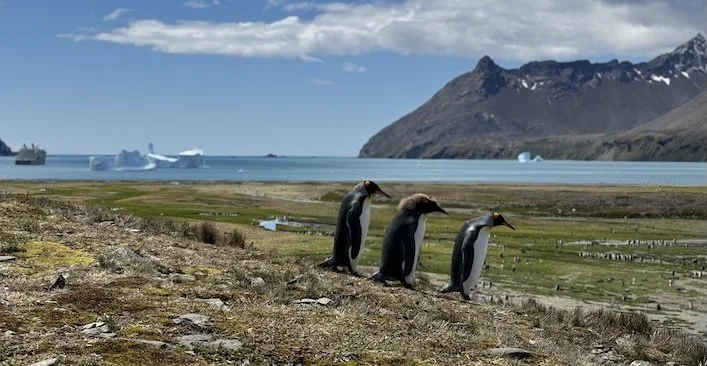
We got an extraordinarily sunny day with barely any wind, which by South Georgia standards is close to a miracle. Fortuna Bay is also where Shackleton's story reaches its actual ending. This is where he, Frank Worsley, and Tom Crean came down over the mountains at the end of their legendary crossing of South Georgia, heading for the whaling station at Stromness to get help for the men still stranded back on Elephant Island. The first people to spot them were two young boys, who apparently took one look at three filthy, half-starved men who'd just walked out of nowhere and ran for their lives. Standing in that same spot, looking at the same mountains they came down, was genuinely spectacular. Especially with squawking penguins providing the soundtrack,
And then there were the king penguins. Thousands of them, huddled together around meltwater pools, walking back and forth in those perfectly straight little lines they do.
Because of the time of year, and because we were far enough north by this point that it had actually gotten warmer, a lot of the king penguin chicks were mid-molt, and it might be the single best thing I photographed on the entire trip. Every penguin species is different, and king penguins have maybe the strangest childhood of all of them. Chicks grow in a thick layer of brown down first, heavy enough to keep them alive through the brutal South Georgia winter. Their actual adult feathers, the sleek waterproof ones they'll wear for the rest of their lives, grow in underneath that down while they're still covered in it. Once those feathers are ready, the chick sheds the brown fuzz, all at once, and comes out looking like the genuinely majestic bird it's about to become. Sailors called these mid-molt chicks oakum boys, after the tarred fiber used to caulk ship timbers, because the brown coloring is a near-perfect match.
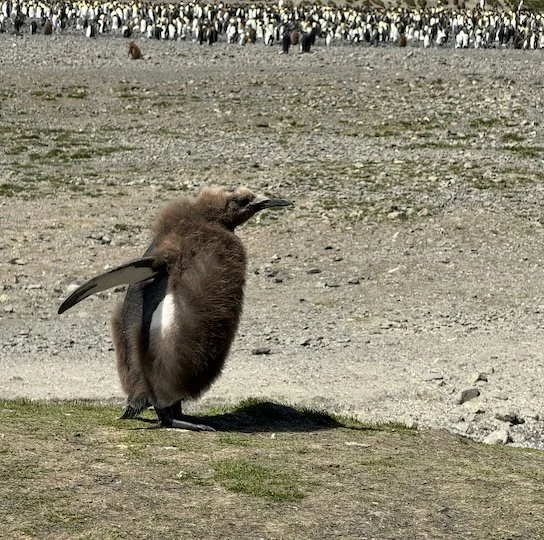
An Oakum boy King Penguin mid molt in Fortuna Bay, South Georgia
Until they've fully molted, oakum boys can't swim, so they're stuck depending on their parents for every meal. Since they're carrying two full layers of feathers at once in weather that's finally warming up, they are visibly, comically overheating the entire time. They’re also hungry, since going into the water is essential for catching the fish they eat. Watching them hound their parents to be fed was pretty hysterical.
This was one of the most extraordinary days of the trip, and it's a big part of why I always tell people Antarctica itself isn't the only way to see penguins. South Georgia does it. The Falklands do it. Even South Africa does it. Antarctica has a kind of beauty that's genuinely its own, though, something that starts to fade the further north you get. In Antarctica, the water itself feels alive. Every direction you look, there's a seal, a penguin, something floating past, a whale surfacing. In South Georgia, that's still mostly true, seals playing, penguins porpoising alongside the ship, but it's a step down from constant. You lose the glaciers with penguins standing on top of them, the penguins swimming through channels of ice, because it's simply too warm here for that anymore. By the time we reached the Falklands, I wouldn't call the water alive at all anymore. There's more shipping traffic through there, and it shows.
