A Day in Stanley, the Falkland Islands' Very British Capital
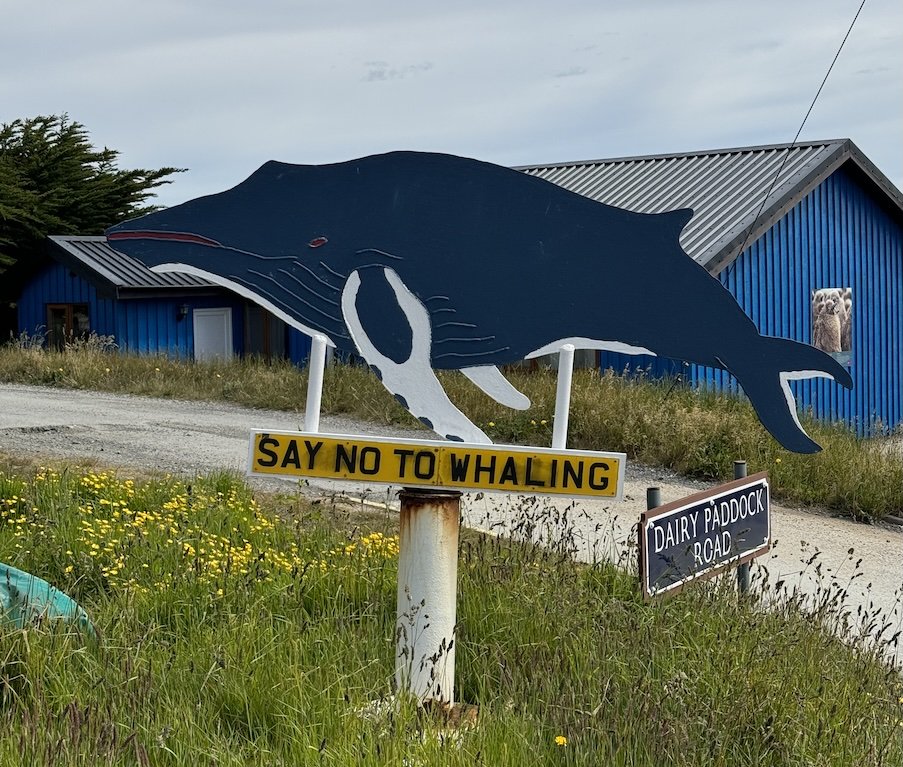
An anti-whaling outdoor museum in Stanley, Falkland Islands
The strangest sight of our Falklands days was a Land Rover Defender rolling down a dirt road with penguins waddling along one side and sheep grazing on the other.
Outside Stanley, much of the Falklands is privately owned farmland, and the wildlife lives right alongside the sheep. Antarctica is governed by an international treaty and South Georgia is a UK territory run for conservation, so after weeks of both, this was a real change. That private ownership is also a big part of what saved these islands. Sealers once burned the coastal tussac grass on purpose to flush seals out into the open, and today many landowners work with groups like Falklands Conservation to protect the land and bring the tussac grass back, along with everything that depends on it.
The Falklands also changed how our landings worked. Until now most of our walks had been short, especially in Antarctica, where we'd step off the Zodiac and be surrounded by penguins within a few feet, and sometimes the expedition team had to guide us through a colony just to reach the path. In the Falklands we had legit hikes, a mile or two from the landing each time, to reach the colonies, and every one of those hikes was worth it.
We started the morning on West Point Island, where we saw Gentoo penguins, goats, and more bird species than I could keep track of, including black-browed albatross chicks nesting right out in the open, impossibly cute even for someone who wouldn't normally call herself a bird person.
The payoff at the end of the hike was our first rockhopper colony, one day after I'd ordered a beer named after them in Stanley before actually encountering one.
Rockhoppers gained their name because they actually hop. They will waddle short distances, but for any amount of speed or length they literally jump like they’re on pogo sticks. Absolutely unique to rockhoppers and a riot to watch.
Just like the other penguins, Rockhopper chicks had been hatching over the past few weeks, and they were nesting right among the albatross chicks, almost like the adults had worked out an unofficial shared childcare arrangement. Every so often a predator bird would swoop in to grab a chick, and it didn't matter whose chick it was after, since every adult nearby, rockhopper and albatross alike, would turn on the intruder together and chase it off.
After the hike we were served tea by the family who ran the island's settlement. We took ours out to the garden and sat there drinking it on an island of goats and penguins in the middle of the South Atlantic, which was such a funny, lovely way to spend a morning. Being handed a proper British tea this far from anywhere is exactly the kind of contrast that makes the Falklands what they are.
In the afternoon we moved on to Saunders Island, which had the kind of beach you'd pick for a swimming vacation, if you could ignore the temperature and the penguins walking out of the surf. The hike out led to a long, sunlit stretch of sand where Gentoo, Magellanic, and King penguins were all together, practically shoulder to shoulder and entirely uninterested in each other. By this point in the trip I'd stopped being surprised that different penguin species share space without acknowledging one another, but seeing three of them mixed together on one gorgeous beach still stopped me in my tracks. We also came across the remains of an old shipwreck along the shoreline, a reminder that this coastline hasn't always been kind to the people who visit it.
Two islands, one garden tea, and more penguins than I could count made for a pretty perfect day, and we still had one more island to go, one that saved the biggest rockhopper colony for last.
